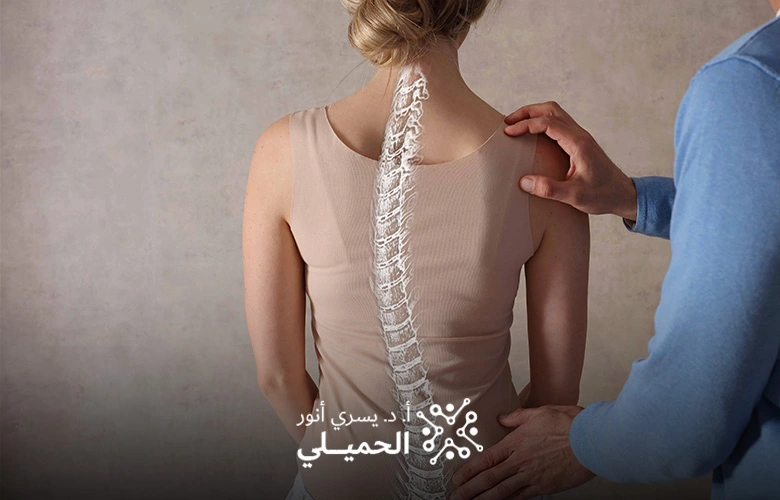
Spinal deformity correction surgeries are precise surgical interventions that aim to correct abnormal curvatures in the spine, such as scoliosis and kyphosis, and restore the patient’s ability to move with greater efficiency. The surgery is performed using advanced techniques mastered by neurosurgeons and spine surgeons, such as navigational surgery, which plays a crucial role in spinal surgeries and its relationship to vital tissues such as the spinal cord and nerve pathways.
How can spinal deformity be detected?
There are several signs that indicate spinal deformity and deviation from its correct position, and these signs include the following:
One shoulder being higher than the other.
Difficulty with movement – particularly movements that require bending – and the patient cannot walk properly (due to uneven pelvic bones).
Deviation in the shape of the spine, appearing twisted instead of straight.
Treatment Methods for Spinal Deformity
There are multiple treatment methods for spinal deformity, including the following:
Wearing back braces.
Physical therapy.
Performing spinal correction surgery (spinal straightening surgery).
Sports that support back muscles.
Candidates for Spinal Correction Surgery
The specialist first determines the degree of spinal curvature and deformity based on clinical examination in the clinic (physical examination), which helps the doctor assess the patient’s movement, along with X-ray imaging of the back to examine the condition of bones and spinal vertebrae. Here are the potential candidates for this surgery:
Patients with scoliosis (lateral curvature of the spine).
Patients with kyphosis (forward curvature of the spine).
Those with spinal stenosis.
Patients suffering from vertebral slippage.
Patients with spinal injuries or fractures.
Patients suffering from chronic pain that has not been resolved by traditional methods.
Results of Spinal Correction Surgery
Spinal correction surgery provides effective results in correcting spinal deformity and its abnormalities, especially in advanced cases that do not respond to treatment with back braces or physical therapy sessions. After surgery, the patient can move easily and engage in sports activities without problems.
Additionally, the patient’s adherence to the rehabilitation program instructions after spinal correction surgery plays a vital role in accelerating the recovery period, enabling the patient to return to normal life more quickly and with high efficiency.