



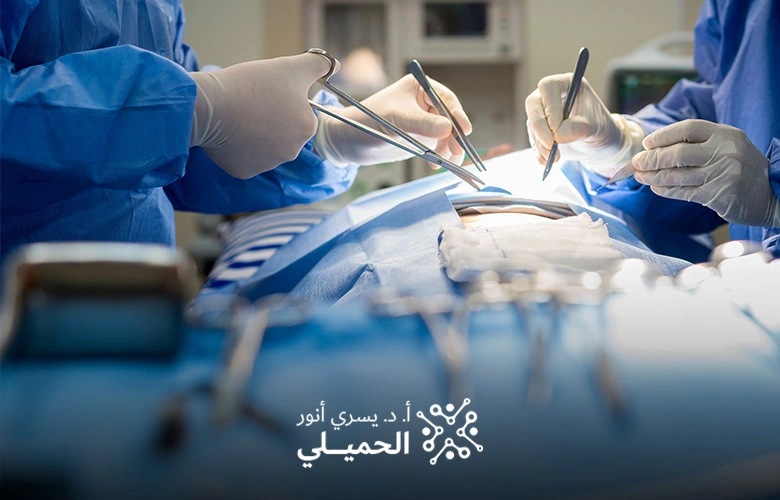
Nerve canal decompression surgeries are vital options for treating spinal problems and eliminating the pain and weakness that accompany them. Professor Dr. Yousre Anwar El-Hemyly – Professor of Neurosurgery and Spine Surgery at the Faculty of Medicine, Cairo University – as a specialized expert in this field, provides advanced surgical services aimed at improving patients’ quality of life and restoring their daily functions. His specialization in this field includes performing operations that help relieve pressure on nerves, especially the spinal canal, and improve the patient’s overall condition. Below are some details.
جدول المحتوي
ToggleWhat is nerve canal decompression surgery?
The spinal canal passes through the vertebrae of the spine and is also called the neural canal, because the spinal cord, which is part of the central nervous system, passes through it. As the spinal cord passes through the spinal canal, many peripheral nerves branch from it and exit to supply different parts of the human body. However, in cases of spinal stenosis caused by age-related changes such as arthritis, joint enlargement, disc bulging, bone spurs, and ligament thickening, this problem leads to pressure on the spinal cord, causing many different troublesome symptoms. Therefore, many people resort to nerve canal or neural canal decompression surgery.
Nerve decompression surgery is performed along the spine from the neck (cervical vertebrae) to the lower back (lumbar vertebrae), by making an incision in the posterior back muscles, where the lamina bone – an anatomical part of the vertebra in the spine – which forms the roof of the spinal canal, is removed.
The surgeon removes the lamina bone and enlarged ligaments to provide more space for the nerves and remove bone spurs. The surgery can involve one or more vertebrae depending on the extent of the stenosis.
Types of nerve canal decompression surgery (spinal canal decompression) that we perform
There are several types of spinal canal decompression surgery:
- Laminectomy Laminectomy: This involves removing the entire lamina bone, part of the enlarged posterior joints, and the enlarged ligaments that cover the spinal cord and nerves.
- Laminotomy Laminotomy: This involves removing a small portion of the lamina bone and ligaments, usually on one side only. The natural support of the lamina bone is left in place, reducing the chance of spinal instability.
- Foraminotomy Foraminotomy: This involves removing bone around the vertebral foramen – the canal through which nerve roots exit the spine. This technique is used when disc degeneration (between vertebrae) causes narrowing of the spinal canal and nerve compression.
- Laminoplasty Laminoplasty: This involves expanding the spinal canal by cutting the lamina bone on one side and opening it like a door. It is used only in the neck (cervical) region.
- Discectomy Discectomy: This involves removing part of a bulging disc to relieve pressure on the nerves.
In some cases, spinal fusion surgery may be performed at the same time to help stabilize sections of the spine that have been treated with laminectomy.
Fusion uses bone grafts, screws, and rods to connect two individual vertebrae together to form one new bone piece. Fusion prevents recurrence of spinal cord stenosis and helps eliminate pain from an unstable spine.
Indications for spinal canal decompression surgery
Indications for spinal canal decompression surgery include the following:
- Persistent pain in the leg or foot, or weakness or numbness in those areas, can be a sign of spinal stenosis and the need for surgical intervention.
- Leg pain that is more severe and bothersome than pain in the back area itself, indicating a problem in the spinal canal.
- When symptoms do not improve after physical therapy or medication use for a period of time, surgery may be the next step.
- Difficulty walking or standing that affects quality of life due to pain or weakness, which impacts the patient’s daily quality of life.
- If diagnostic imaging such as MRI and CT scan shows narrowing in the spinal canal.
How is spinal canal decompression surgery performed in our center?
During spinal canal decompression surgery, the surgeon follows these steps:
1. Patient preparation
- The patient is placed on their back on the operating table and anesthetized. After the patient falls asleep, they are turned onto their stomach with the front and side of the chest supported by pillows.
- The area where the incision will be made is sterilized and prepared.
- If spinal fusion is planned, the hip area is prepared to obtain a bone graft.
2. Making an incision
- An incision is made in the skin along the back over the target vertebrae.
- The back muscles are opened and the patient is moved laterally to expose the lamina bone in each vertebra.
3. Laminectomy or partial laminectomy
- The spinous process is removed, and the lamina bone is removed using a drill or bone cutting tools.
- The ligament connecting the lamina bone to the lower vertebra is removed.
- The same steps are repeated for the target vertebrae.
- In some cases, the surgeon may not want to remove the entire lamina bone. A small opening in the lamina bone above and below the spinal nerve root may be sufficient to relieve pressure.
4. Spinal cord decompression
- After removing the lamina bone and the ligament connecting the lamina bone to the vertebra (ligamentum flavum), the protective covering of the spinal cord (dura mater) can be seen.
- The surgeon gently moves the protective covering of the spinal cord and nerve roots to remove bone spurs and enlarged ligaments.
5. Spinal nerve decompression
The vertebral joint, located directly above the nerve roots, can be trimmed to provide more space for the nerve roots. This method is called foraminotomy and works to widen the neural canal (where spinal nerves exit the spinal canal). If a herniated disc is causing pressure, the surgeon will perform a discectomy.
Spinal fusion
If there is spinal instability or decompression has been performed on multiple vertebrae, spinal fusion may be performed. Fusion is performed by placing a bone graft secured with instruments such as plates and vertebral screws, aimed at uniting the vertebrae to form one solid bone piece. The surgical site is then closed and the muscles and skin are sutured together with stitches or staples.
After spinal canal decompression surgery
Once you wake up from surgery, you will be transferred to the surgical recovery area where your body functions such as blood pressure, heart rate, and breathing will be monitored, and you will receive necessary treatment to relieve pain.
Once you are fully awake, you will be transferred to a regular room where you will begin to increase your level of physical activity, such as sitting in a chair or walking slowly.
Here are some tips and instructions that Professor Dr. Yousre and his team often provide after such surgeries:
- Avoid bending or twisting the back to avoid putting pressure on the wound.
- It is recommended not to lift anything heavy to maintain wound safety.
- Avoid strenuous activities such as driving or heavy work until you regain sufficient strength.
- It is recommended not to drink alcohol to avoid negative interactions with medications.
- Ice should be applied to the wound area regularly to reduce pain and swelling.
- It is recommended to change sitting or lying positions regularly to avoid muscle stiffness and wound adhesion.
- Short walking sessions should be done regularly to promote blood circulation and improve wound healing.
- Pain medications should be taken regularly as prescribed by the doctor, and the dose should be gradually reduced once symptoms improve.
- Stool softeners should be taken if pain medications cause constipation.
- Contact your doctor immediately in the following cases:
- If your temperature is elevated.
- In case of persistent vomiting or severe nausea.
- If signs of infection appear at the wound site, such as severe redness or wound swelling.
- If you experience severe itching or skin rash in the area around the wound.
- If new symptoms appear such as leg swelling and sensitivity, or new numbness and weakness in the extremities.
Best surgeon for nerve canal decompression surgery
Undoubtedly, Prof. Dr. Yousre Anwar El-Hemyly is considered one of the most prominent surgeons in nerve canal decompression surgery for the following reasons:
- Prof. Dr. Yousre El-Hemyly is considered one of the best nerve canal decompression surgeons thanks to his extensive experience and exceptional surgical skills.
- Professor Dr. Yousre enjoys an excellent reputation and a distinguished record of success in performing nerve canal decompression surgeries.
- Dr. Yousre provides personal and professional care to each patient, putting their needs and safety first.
- Dr. Yousre collaborates with a specialized and well-trained medical team to ensure comprehensive and effective treatment for patients.
- Dr. Yousre is committed to providing comprehensive guidance and direction to patients before and after surgery, including wound care and necessary instructions for quick and successful recovery.
- Prof. Dr. Yousre is considered the optimal choice for anyone looking for an experienced and highly competent surgeon in the field of nerve canal decompression.
If you suffer from spinal pain or have any other brain problem that affects your quality of life, contact Professor Dr. Yousre El-Hemyly’s team today for a personal consultation and direct assessment. Let them provide you with appropriate medical care and an effective treatment plan that meets your health needs and ensures comfort and quick recovery.

For direct booking
Book Now